.svg)
Future of Maritime Operations Depends on Mission Adaptability of USVs
.avif)
Over the past decade, unmanned surface vehicles (USVs) have evolved from experimental to essential Warfighter assets. Across the Navy, Marine Corps, Army, and Coast Guard, these platforms are proving their worth in missions ranging from persistent maritime patrols to ship-to-shore logistics and port security. Yet despite rapid technical progress, the broader USV market continues to struggle with endurance, resilience, and the ability to shift missions quickly in austere environments.
The issue isn’t capability on paper – it’s adaptability in the field. Swapping payloads often requires depot-level support, and extended missions reveal the limits of hull endurance, configurability, and reliability when operating far from infrastructure. The result is a fleet that performs well in trials but faces constraints when forward deployed.
The Need for Mission Flexibility
Modern naval doctrine, including Distributed Maritime Operations (DMO) and Special Operations Forces concepts, envisions small USVs performing diverse roles such as ISR, electronic warfare, communications relay, counter-UAS, and limited strike missions. In this context, advantage comes not from any single payload, but from how quickly and reliably a platform can expand and shift its capabilities in contested, covert environments.
Traditional acquisition processes, which can take months or years for new system integration, undermine needed agility in dynamic maritime theaters. Even modular systems often require depot-level support, delaying response times at sea. True operational breakthrough lies with platforms that combine long-range endurance, substantial payload capacity, and rapid mission reconfiguration – critical enablers for maintaining lethality and adaptability across distributed maritime missions.
Designing for Mission, Endurance, and Resilience
Mission-first design starts with the Concept of Operations (CONOP) – the missions the system must successfully execute under the conditions it must endure. Core principles include:
- Rapid Modularity – Platform that can be outfitted with multiple diverse payloads with standardized mechanical, electrical, and data interfaces allowing payload swaps at the pier, not the depot. One hull, multi-mission variants.
- Open Architectures – Government standards like UMAA allow new payloads to integrate seamlessly with autonomy software, from own ship core control to collaborative multi-domain autonomy.
- Resilient Payload Bays – Below-deck payload placement conceals and protects equipment from environmental exposure, improves stability, and enhances survivability in rough seas.
- Operational Endurance – Propulsion efficiency and low-power standby modes extend availability under prolonged deployment.
The MV-20: Proof of Mission-First Design
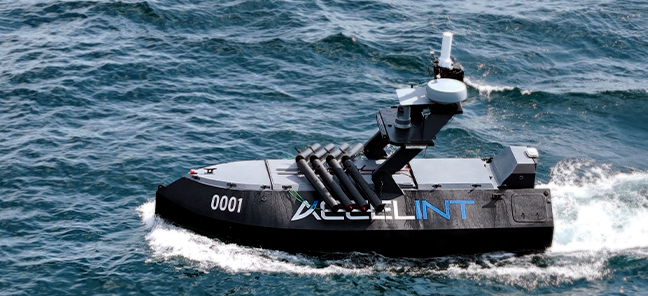
The MV-20 sUSV translates mission adaptability, endurance, and resilience into operationally relevant capability. Its below-deck modular payload bays, open system interfaces, and substantial payload capacity enable rapid in-theater mission reconfiguration, reducing integration from days or weeks to hours – a critical advantage for Special Warfare and Distributed Maritime Operations (DMO).
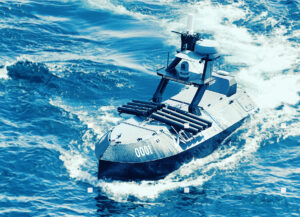
With a diesel-efficient range exceeding 1,300 nautical miles, self-righting aluminum hull, and ultra-low-power standby, the MV-20 sustains prolonged forward presence with minimal maintenance, directly supporting Navy priorities in contested littorals. Its commercial-off-the-shelf design broadens supply chain access domestically and among coalition partners, enhancing interoperability and resilience.
This flexibility redefines unmanned surface warfare by combining rapid mission reconfiguration with long-range endurance and manned-unmanned teaming – delivering forward ISR, electronic warfare, and logistics effect across contested and denied waters without increasing risk to personnel.
Building a Multi-Mission Ecosystem
True multi-mission capability depends on more than a single platform – it requires an ecosystem that rewards adaptability. As resource sponsors define unmanned requirements for multiple mission sets, and program offices enforce open systems and integration speed, unmanned systems can evolve in stride with the threat. Operational evaluation should measure:
- Integration speed – What is the platform’s validated timeline and required personnel, tools, and facilities to perform payload swaps, ensuring rapid mission turnaround?
- Validation of open standards – Does the platform meet UMAA compliance and interface with external payloads, autonomy and C2 systems?
- Mission design margin – Does the platform provide sufficient power, thermal management, and payload capacity margins to reliably support evolving payloads and sustain multi-day, high-tempo operations?
- Realistic testing – Are reconfiguration speed, system resilience, and operational endurance rigorously validated through progressive experimentation in challenging sea states and sustained, mission-driven military conditions?
When these factors align, small USVs extend reach, complicate adversary targeting cycles, and enable persistent distributed operations that sustain tactical and operational advantage.
Redefining Operational Advantage
The future of unmanned maritime operations will be defined not by raw performance specs but by the speed of mission evolution. Adversaries may match range or speed, but replicating the ability to execute and sustain multiple mission threads in austere or contested environments is far more challenging.
As distributed maritime operations mature, success will hinge on how rapidly capability can shift across the fleet. Platforms like the MV-20 show what that future looks like: agility and mission focus working together to accelerate operational tempo and extend relevance through every phase of the fight.
Built for the Mission
In contested waters, endurance is defined by the ability to adapt – transforming flexibility into sustained operational advantage. The MV-20 isn’t just a vessel; it’s proof that when modularity meets mission discipline, flexibility becomes a weapon.
Start the Conversation
Get in touch to discuss how Accelint’s solutions can support your mission objectives.
Contact